Why profile design is crucial in aluminium extrusion
Efficiency in aluminium extrusion depends directly on the profile design. The geometry of the section influences the extrusion speed, die wear, energy consumption and final product quality.
In industrial terms, an optimised profile allows for:
- Increased production speed
- Lower working pressure
- Reduction in energy consumption per tonne
- Fewer surface and dimensional defects
- Longer tool life
When the design is carried out taking into account the behaviour of the material during plastic deformation, the process becomes more stable, cost-effective and competitive.
Geometry and extrusion force
One of the most decisive factors in the efficiency of the process is the perimeter/area ratio.
Profiles with high perimeters relative to their cross-section generate greater friction in the die, require higher pressures, and reduce the extrusion speed. This directly impacts:
- Energy consumption
- Tool wear
- Production capacity
Also, abrupt transitions in thickness cause internal differences in aluminium flow, leading to deformations, warping and tolerance deviations.
Profile complexity: benefits and limitations
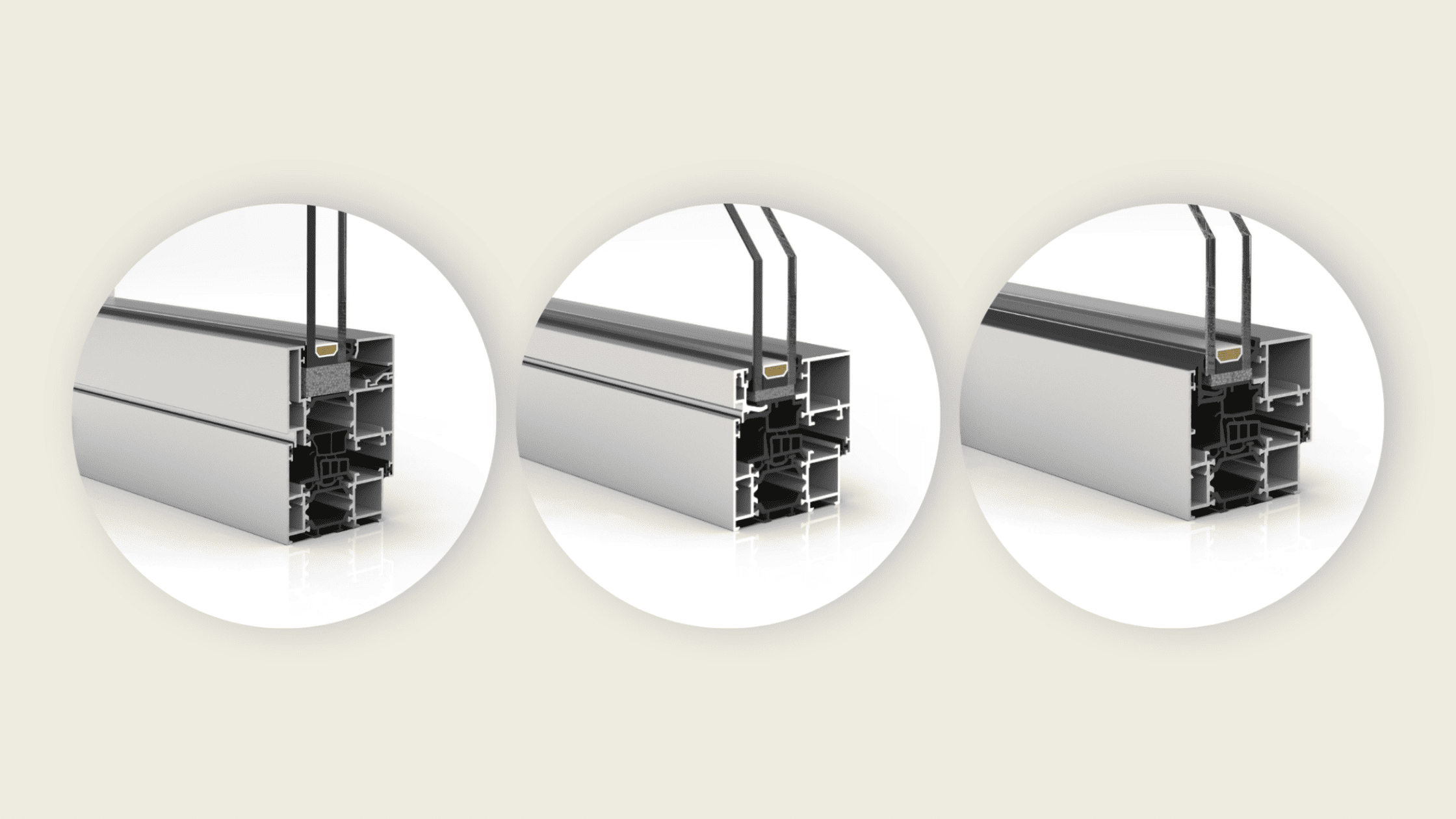
Aluminium extrusion allows profiles with complex geometries to be manufactured: internal chambers, grooves, fins or recessed sections. However, greater complexity implies:
- More demanding matrix design
- Greater sensitivity to temperature variations
- Need to reduce speed to maintain surface quality
Profiles with thin fins or narrow or recessed channels require process adjustments that affect efficiency.
From an industrial optimisation perspective, simplifying critical areas promotes uniform flow, reduces defects and allows for higher speeds without compromising quality.
Symmetry and flow balance
The symmetry of the profile optimises mould filling, reduces internal stresses and minimises deformations such as warping. This speeds up set-up and stabilises production.
In multi-outlet matrices, a balanced design ensures uniform flow distribution between channels, avoiding quality variations, frequent adjustments, and unplanned downtime.
Critical details: radii, transitions, and thicknesses
Small adjustments to the design transform efficiency:
- Generous radius and rounded corners prevent stress concentrations and dead metal zones.
- Smooth transitions stabilise the flow; abrupt changes force you to sacrifice speed.
- Avoiding extremely thin or long fins prolongs the life of the die and improves surface finishes.
These details resolve quality issues before they arise in production.
Impact on costs and performance
An optimised design generates measurable benefits:
- Less force required → reduction in energy consumption per tonne.
- Less die wear → longer tool life.
- Reduction in rejects → improved material yield.
- Quick set-ups → increased productive time.
Designing ‘with extrusion in mind’ makes the profile a factor in industrial competitiveness.
Designing for better production
Integrating extrusion criteria from the design stage increases process efficiency. Thus, the profile not only fulfils mechanical or aesthetic functions, but also optimises energy, quality and productivity.
In this way, collaboration between product and process engineering transforms extrusion into a competitive advantage, with high-quality products at controlled costs.
Frequently asked questions about profile design and extrusion
Why does profile design affect aluminium extrusion efficiency?
Because the geometry of the profile determines how the aluminium flows through the die. Factors such as the perimeter/area ratio, thickness changes and symmetry influence the pressure required, the extrusion speed, energy consumption and the final quality of the product.
An optimised design reduces friction, stabilises flow and improves productivity.
What geometries make aluminium extrusion difficult?
Profiles with:
- Very thin fins
- Narrow channels
- Highly variable thicknesses
- Complex asymmetrical sections
require greater process control and lower speeds to avoid defects such as warping, twisting or poor surface quality.
How does the perimeter/area ratio influence extrusion?
A high perimeter/area ratio increases friction between the aluminium and the die. This requires greater pressure, increases energy consumption and accelerates tool wear.
Balanced designs enable higher speeds and lower costs per tonne extruded.
Does profile symmetry improve the quality of the extruded product?
Yes. Symmetry promotes uniform metal flow, reduces internal stresses and minimises deformation. In multi-outlet dies, it also helps maintain dimensional stability and homogeneity between profiles.
What design elements extend the service life of the die?
- Generous corner radii
- Smooth transitions between thicknesses
- Balanced thicknesses
- Removal of extremely fine details
These adjustments reduce stress concentrations and dead metal zones, thereby reducing wear.
Can energy consumption be reduced by optimising the profile design?
Yes. A profile designed with extrusion in mind requires less force to deform, which reduces working pressure and energy consumption per tonne produced.
The design has a direct impact on the energy efficiency of the process.